


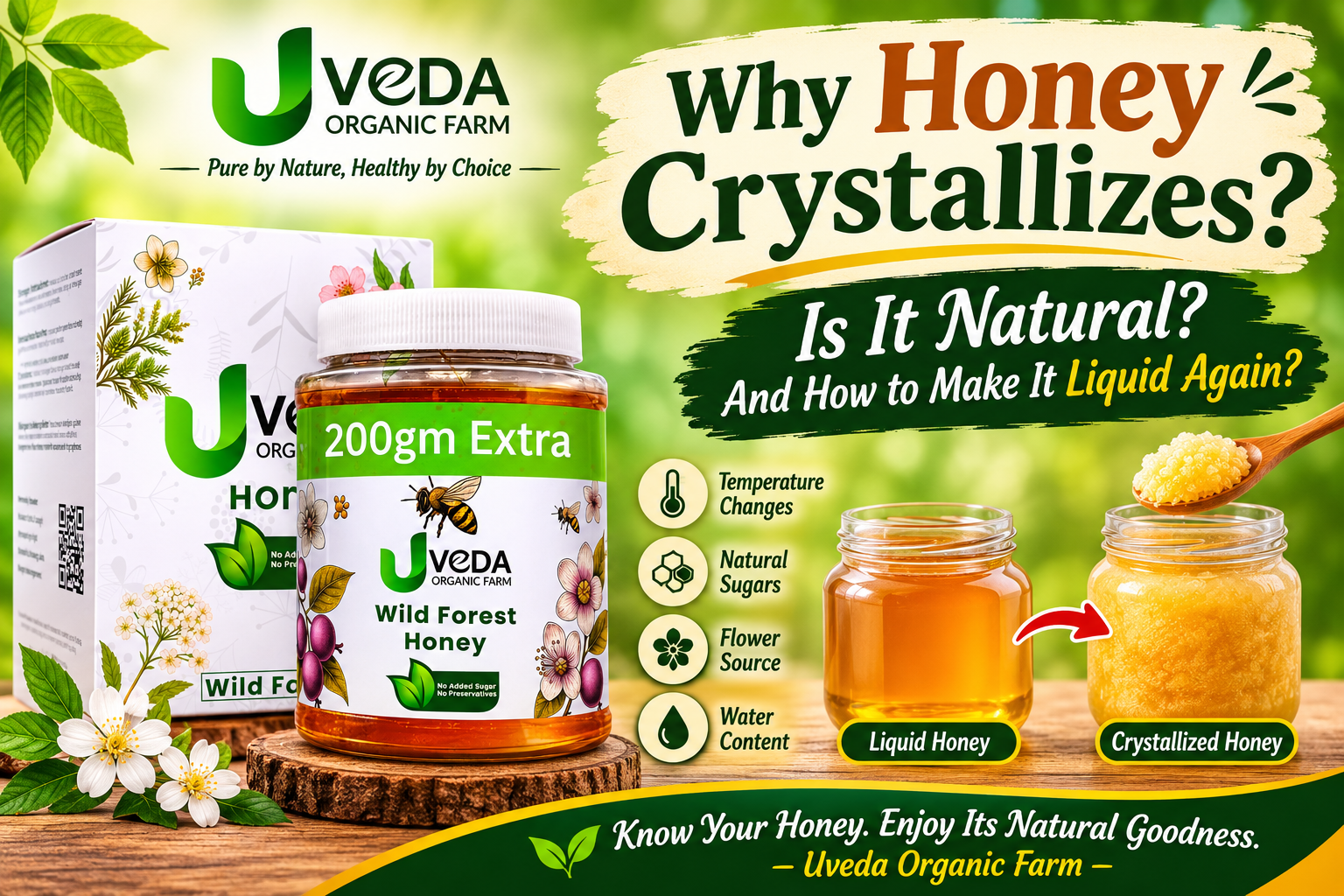
Have you ever opened a jar of honey expecting to pour a golden, smooth liquid, only to find it thick, grainy, or almost solid? If this has happened to you, you are not alone.
Many people in India notice this change during winter, especially when temperatures drop. Their first thought is often, “Has my honey gone bad?” or “Is this honey pure?”
The good news is that honey crystallization is a natural process that usually does not mean your honey has spoiled. In fact, it is a common characteristic of natural honey.
At Uveda Organic Farm, we believe that understanding your food helps you enjoy it better. So, let’s explore why honey crystallizes, what affects the process, and how you can bring your honey back to its smooth, liquid consistency.
What Is Honey Crystallization?
Honey crystallization is the natural process in which liquid honey gradually becomes thick, grainy, or solid as some of its natural sugars form crystals.
You may notice:
- Honey becoming cloudy or opaque
- Small sugar crystals appearing at the bottom of the jar
- A thick, creamy texture
- Honey becoming difficult to pour
- A layer of liquid honey forming above the crystals
These changes are normal and are mainly related to the natural sugar composition of honey.
According to the Food Safety and Standards Authority of India (FSSAI), honey can naturally be fluid, viscous, partially crystallized, or completely crystallized.
This means that crystallized honey is not automatically adulterated or spoiled.
Why Honey Crystallizes: The Science Behind It
The main reason honey crystallizes is its natural sugar content.
Honey contains two major sugars:
- Glucose: A natural sugar that tends to form crystals more easily.
- Fructose: A natural sugar that generally stays dissolved in honey for longer.
Honey also contains water, small amounts of minerals, enzymes, pollen, and other naturally occurring substances.
Because honey contains more sugar than its water can easily keep dissolved, it is known as a supersaturated sugar solution.
Over time, excess glucose begins to separate from the liquid and forms tiny crystals. These crystals gradually grow, making the honey thicker and sometimes completely solid.
This process is called honey granulation or honey crystallization.
5 Main Reasons Why Honey Crystallizes
1. Natural Glucose and Fructose Content
The ratio of glucose to fructose plays a major role in determining how quickly honey crystallizes.
Honey with a higher glucose content generally crystallizes faster, while honey with more fructose tends to remain liquid for longer.
For example, some floral honeys crystallize relatively quickly, while acacia honey is often slower to crystallize.
This is one reason different varieties of honey can have different textures, even when both are natural and unadulterated.
2. Temperature Changes During Storage
Temperature is another important factor affecting honey crystallization.
Honey often crystallizes more quickly when stored at temperatures around 10°C to 15°C. This is why you may notice honey becoming thicker during the winter months.
In India, cooler weather can make honey crystallization more noticeable, particularly in homes where jars are kept in cool kitchens or cupboards.
Interestingly, very cold temperatures can slow the movement of sugar molecules, while warmer temperatures help crystals dissolve.
This is why the way you store honey can influence its texture.
3. Natural Pollen and Tiny Particles
Raw honey may contain tiny amounts of naturally occurring pollen, beeswax, and other microscopic particles.
These particles can act as starting points for sugar crystals to form.
As glucose begins to crystallize around these particles, the crystals gradually become larger.
This is one reason minimally processed honey may crystallize differently from heavily filtered or heat-treated honey.
However, the presence or absence of crystallization alone cannot confirm whether honey is pure.
4. Water Content in Honey
The natural moisture content of honey also influences its crystallization.
Honey with relatively less water and a higher glucose concentration may crystallize more quickly.
The balance between sugar and water affects how easily glucose remains dissolved.
This is why honey from different floral sources can have different crystallization patterns, even when stored under similar conditions.
5. Type of Flowers Visited by Honeybees
The flowers from which bees collect nectar influence the natural composition of honey.
Different floral sources produce honey with different glucose and fructose ratios, which affects its texture and crystallization speed.
For example:
| Honey variety | Typical crystallization tendency |
|---|---|
| Acacia Honey | Generally crystallizes slowly |
| Sunflower Honey | Often crystallizes relatively quickly |
| Multiflora Honey | Can crystallize at varying rates |
| Wild Forest Honey | Depends on its floral composition |
| Litchi Honey | May remain liquid for some time, depending on its composition |
These are general tendencies. Actual crystallization can vary from batch to batch depending on nectar composition and storage conditions.
Is Crystallized Honey Pure or Adulterated?
This is one of the most common questions people ask when their honey becomes thick.
Crystallized honey can be completely natural and pure.
The formation of crystals happens because of the natural sugars present in honey. It does not mean that sugar has been added or that the honey has lost its original quality.
However, it is important to understand one thing: crystallization is not a guaranteed purity test.
Some genuine honey varieties remain liquid for a long time, while some adulterated honey may also crystallize under certain conditions.
Therefore, you should not judge honey purity by texture alone.
For better confidence, choose honey from a trustworthy source that provides transparent product information and follows appropriate quality and food-safety standards.
How to Make Crystallized Honey Liquid Again
If your honey has become thick or solid, there is no need to throw it away.
You can gently warm it to dissolve the sugar crystals.
The Warm Water Method
Follow these simple steps:
- Fill a bowl or saucepan with warm water.
- Place your tightly closed honey jar in the warm water.
- Make sure the water level stays below the jar’s lid.
- Allow the honey to warm gradually.
- Gently stir the honey if possible.
- Remove the jar once the crystals have dissolved.
For better quality preservation, keep the water comfortably warm and avoid excessive heating. A temperature around 35°C to 40°C is a practical gentle-warming range.
If the honey is heavily crystallized, the process may take longer.
Important: Avoid boiling honey or heating it directly over a flame. Excessive heat can affect its natural aroma, flavour, and heat-sensitive components.
How to Store Honey to Slow Crystallization
Although crystallization cannot always be prevented, proper storage can help maintain the consistency you prefer.
Here are a few simple tips:
- Store honey in a tightly closed container.
- Keep it in a cool, dry place away from direct sunlight.
- Avoid unnecessary temperature changes.
- Use a clean, dry spoon every time.
- Keep the jar away from moisture.
- Avoid storing honey in the refrigerator if you want it to remain liquid for longer.
For everyday use, a dry kitchen cupboard away from heat and sunlight is usually a good choice.
Remember that crystallization is a natural process. Even with proper storage, honey may eventually become thick.
Can You Eat Crystallized Honey?
Yes, crystallized honey is generally safe to eat if it has been properly stored and shows no signs of spoilage.
You can enjoy it in many ways:
- Spread it on toast or roti.
- Mix it into warm milk.
- Add it to tea after the tea has cooled slightly.
- Use it in homemade salad dressings.
- Add it to breakfast bowls or oatmeal.
- Enjoy it directly with a spoon.
Some people even prefer crystallized honey because its thicker texture makes it easier to spread.
If honey develops an unusual sour smell, foaming, or other signs of fermentation, do not assume these changes are simply crystallization.
Frequently Asked Questions About Honey Crystallization
1. Why does honey crystallize in winter?
Honey often crystallizes faster in cool conditions, particularly around 10°C to 15°C. This makes the process more noticeable during winter in many parts of India.
2. Does crystallized honey mean it is organic?
No. Crystallization is a natural physical process and does not establish whether honey is organic. Organic status depends on the applicable certification and production standards.
3. Why is my honey hard at the bottom but liquid at the top?
This happens when glucose crystals form and settle at the bottom while the remaining liquid contains more dissolved sugars and water.
It is a common crystallization pattern and is not automatically a sign of poor quality.
4. Does raw honey crystallize faster?
Raw honey may crystallize more readily because it can contain natural particles that help crystals form. However, the speed also depends on its sugar composition and storage conditions.
5. Can crystallized honey be used for cooking?
Yes. Crystallized honey can be used in cooking, baking, marinades, and other recipes just like liquid honey. You can also gently warm it if a recipe requires a pourable consistency.
Enjoy Natural Honey with Uveda Organic Farm
Honey is one of nature’s simplest and most wonderful foods. Its colour, flavour, aroma, and texture can vary depending on the flowers visited by bees and the conditions in which it is stored.
At Uveda Organic Farm, we believe that understanding these natural differences helps people make better choices for their kitchens.
Whether you enjoy the rich flavour of Wild Forest Honey, the mild sweetness of Kashmiri Acacia Honey, or the everyday taste of Raw Organic Honey, remember that natural honey does not always have to remain perfectly liquid.
The next time you notice crystals forming in your honey jar, do not worry. It may simply be nature doing what it does best.
Explore natural honey varieties from Uveda Organic Farm:
Choose honey you can enjoy with confidence, one spoonful at a time.